
The Metabolic Test Longevity Seekers Should Be Doing
What the usual tests leave out.

This article is part of our physiological assessment series.
If you are training for longevity, you most likely already know about VO₂Max — the maximum rate at which your body can use oxygen.
However, you might not know of the different ways to test for it.
For instance, I recently launched an advanced testing method, the first of its kind in Singapore:
A two-in-one VO₂Max and lactate threshold test, run in a single session.
It has multiple advantages over a standalone VO₂Max test, and here is how the two compare.
How Our Test Compares to a Standard VO₂Max Test
Here’s a table to summarise the key differences:
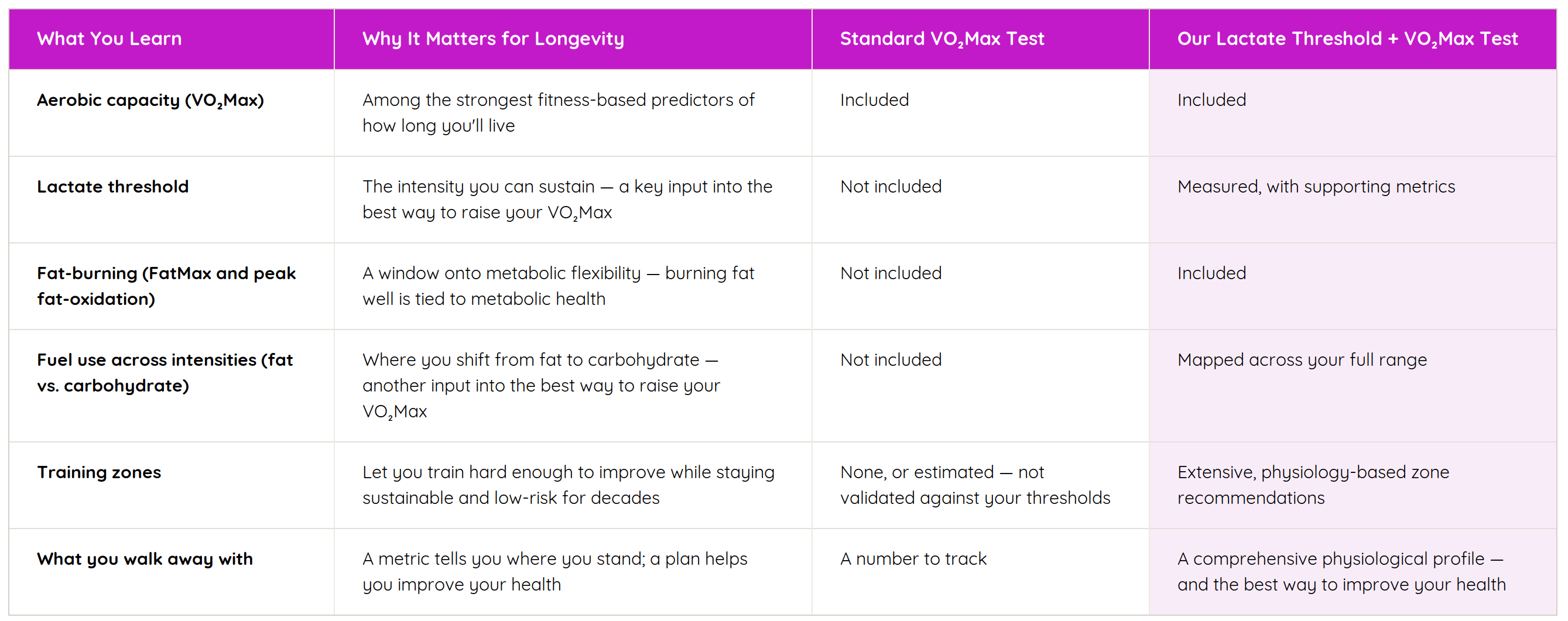
Of note, our test requires the same effort as a standard one.
Everything in that right-hand column comes from a single visit rather than the separate sessions you would otherwise need to measure thresholds, fat-burning and zones.
Since every metric is read from the same effort, they describe one consistent snapshot of your physiology, not numbers stitched together from tests done on different days.
You also spend no more time and do no more work; you simply come away with much more to act on.
Metabolic Health a VO₂Max Test Misses
A VO₂Max test only reflects your aerobic capacity.
Our report, however, also shows you how you use fuel: how much fat versus carbohydrate you burn at each intensity, the intensity at which fat-burning peaks (FatMax), and your maximal fat-oxidation rate.
These matter for longevity.
The broader ability to switch cleanly between fuels — metabolic flexibility — is a feature of metabolic health, and its loss is a hallmark of insulin resistance, obesity and type 2 diabetes (Goodpaster & Sparks, 2017).
Training that builds fat-oxidation capacity, improves your fuel-switching (Maunder et al., 2018; Romijn et al., 1993; Achten et al., 2002), and is foundational for your health.
The fuel-use curve mapped out in your report is therefore useful for health tracking.
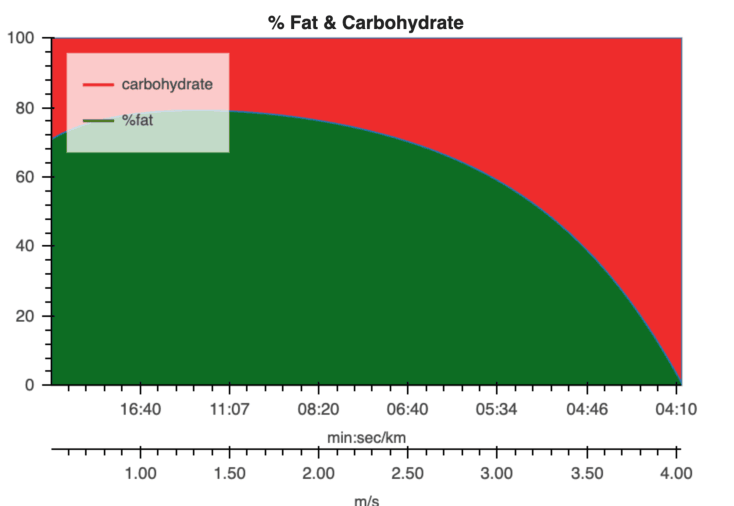
As intensity increases, everyone shifts from burning mostly fat to burning mostly carbohydrate; the point where carbohydrate takes over is the crossover point (Brooks & Mercier, 1994).
Where yours sits and how steeply fat oxidation falls away around it are highly individual.
Optimised workouts push that crossover to higher intensities, so you draw on fat further up your range and spare carbohydrate for when it counts.
Another way to see this is by comparing professional endurance athletes, moderately active people and individuals with metabolic syndrome.
The same pattern separates them:
The fitter and more metabolically healthy the person, the more fat they oxidise at a given intensity and the later their lactate climbs, while metabolic inflexibility shows up as an early switch to carbohydrate and higher lactate for the same effort (San-Millán & Brooks, 2018).
Although our test does not diagnose anything, the fat-oxidation and lactate responses it captures lie on the same spectrum that separates metabolic health from metabolic inflexibility — making them worth tracking over time.
Get a Plan That Optimises Your Health
A standard VO₂Max test gives you your number, but not how to raise it.
Our test does both.
Its report is a full physiological profile that pinpoints your actual limiter — aerobic ceiling, threshold, fat-burning, etc.
And that matters, because the best way to train is different for each.
Additionally, knowing your physiological profile enables us to optimise your training intensity recommendation rather than relying on generic age-based percentages, which can place the right intensity well off the mark for any given individual (Iannetta et al., 2020; Jamnick et al., 2020).
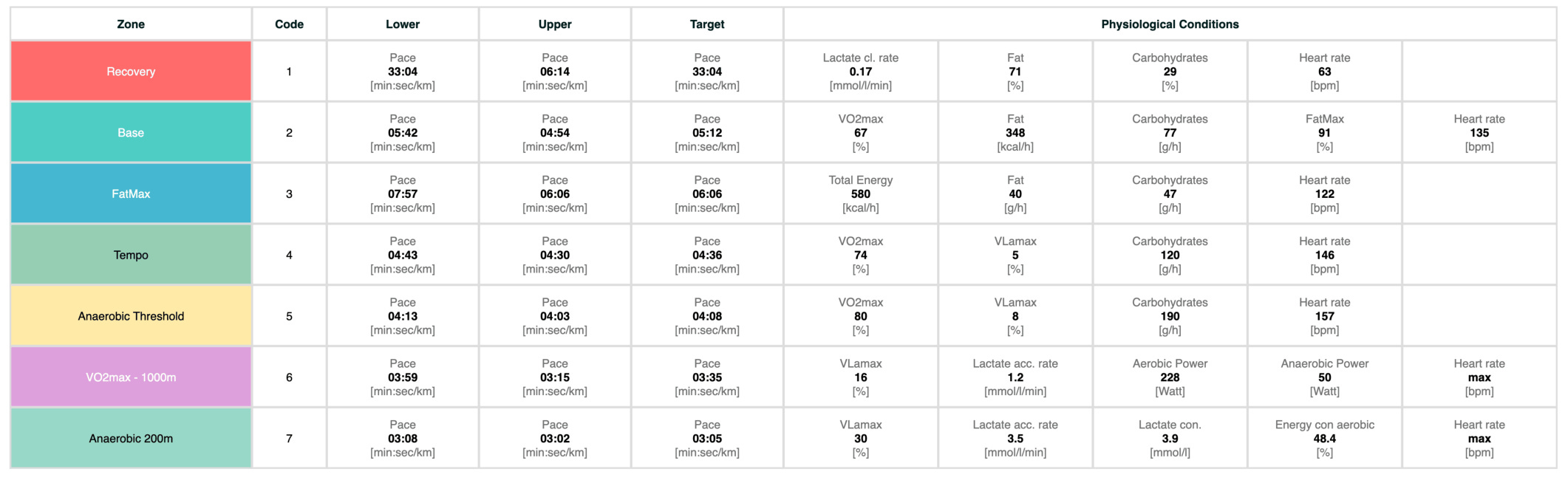
On the same note, the recommended amount of time to work out at each intensity would also vary based on your results.
For instance, improving your VO₂Max does not always mean prioritising your VO₂Max intervals.
Such workouts do not address the aerobic base that supports a long, capable life — capillary supply, fat-oxidation capacity, and the cardiac and blood-volume adaptations of endurance.
And such a base, which can raise your VO₂Max, is developed through a high volume of lower-intensity work.
To give you a general idea, in people who already train, a polarised mix of roughly 80% low-intensity and 20% high-intensity work raises VO₂Max and other endurance markers more than interval-only, threshold-only or volume-only training (Seiler, 2010; Stöggl & Sperlich, 2014).
That said, your exact ratio can vary greatly.
Variables include your recent exercise history, sporting background, etc.
Another point is that with our test, you get recommended exercise intensities with both pace and heart rate targets, along with the energy cost.
Such extensive, actionable information is uncommon in physiological tests.
But they are valuable for getting the most bang for your buck in training.
And to top things off, these metrics serve as checkpoints for physiological changes and for updating training recommendations whenever you do a retest.
How a 12-Lead ECG VO₂Max Test Compares
Before I conclude, I want to make a quick comparison to VO₂Max testing performed alongside a 12-lead ECG.
They are included in many longevity-oriented health screens, and many cardiologists offer them as well.
My key message is that they are a different tool for a different job — our test does not replace it, and those tests remain important in their own right.
By adding the ECG, the session turns into a concurrent cardiac stress test:
It monitors your heart’s rhythm and electrical signals during maximal exertion to screen for arrhythmias or signs of reduced blood flow.
Here’s a table to summarise what each test looks into:
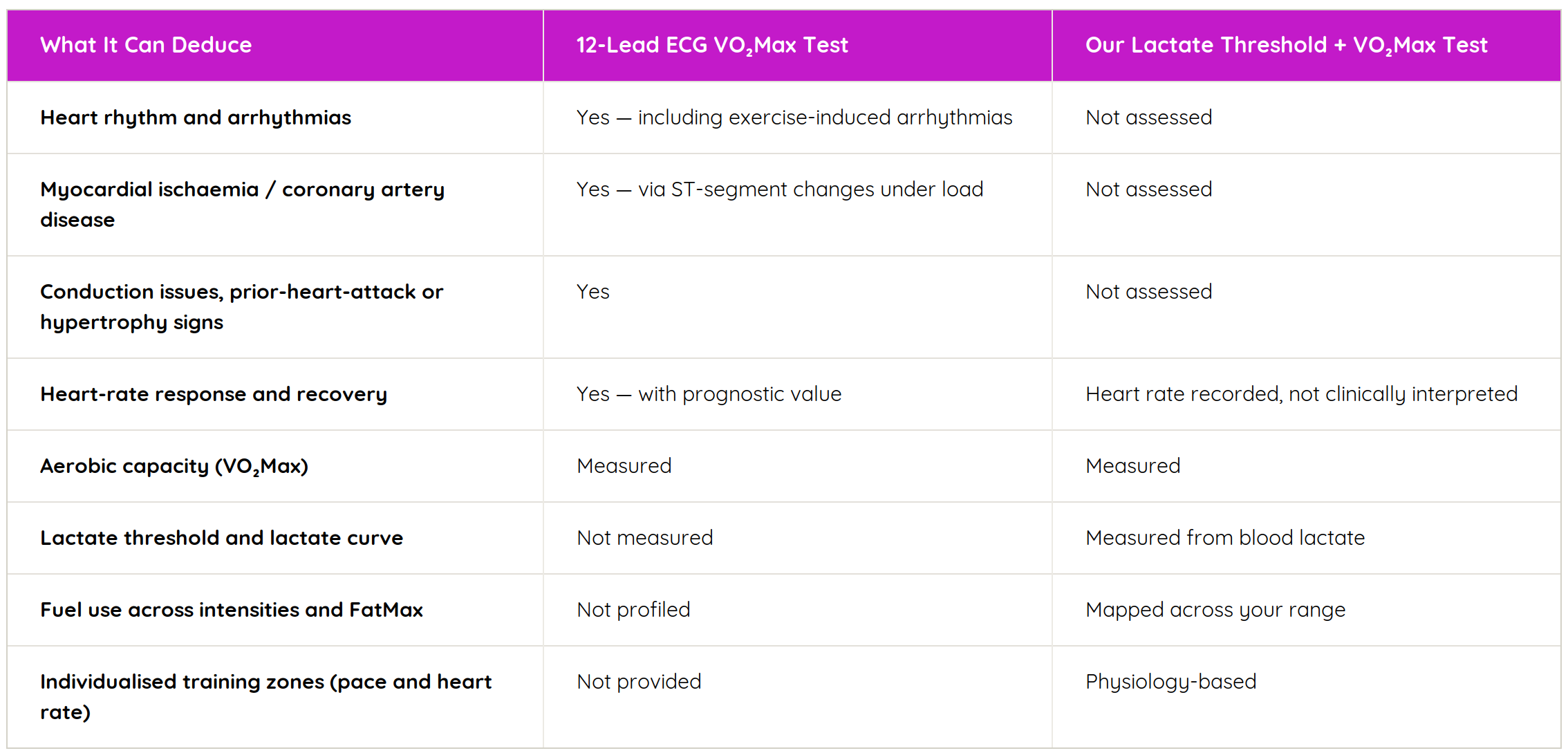
Again, I emphasise that nothing in my company’s test replaces a medically supervised cardiac screening.
In fact, if we deem it more suitable for you, we would make a referral.
Is there, in that case, still value in taking my company’s test?
Well, the main considerations surround clear training recommendations.
Part of the reason is the protocol – the standard clinical version is typically run on the Bruce protocol, where the treadmill steps up in three-minute stages, with both speed and incline rising together, starting at a brisk uphill walk at a 10% grade.
That is an efficient way to drive the heart to its limit for diagnosis, but the early and middle stages are walking and jogging up a steep hill.
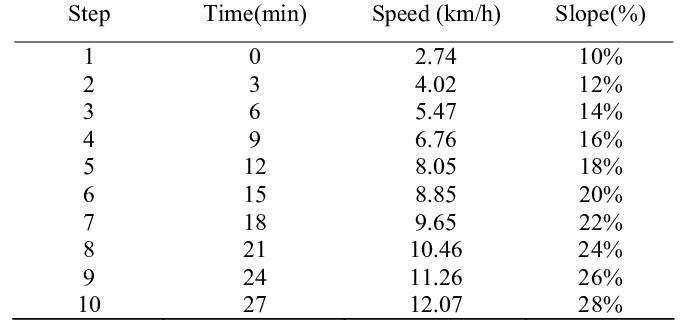
They are different from the flat running you actually train and race on.
On the other hand, our test maintains a constant 1.0% incline throughout, while the speed increases.
That 1% gradient is the established convention for matching the energy cost of running on the flat outdoors, since the lack of air resistance indoors otherwise makes it slightly easier (Jones & Doust, 1996).
Because you are running close to flat the whole way, the paces it produces — your threshold pace, your FatMax pace, your zone paces — are the paces you will actually run on the road, so they carry straight into your training.
A Bruce-protocol test can still give you a sound VO₂Max, but its uphill, walk-to-run speeds do not translate into “run at this pace” the way ours do.
The other difference between the two tests is frequency of testing.
An ECG is usually a baseline or as-needed cardiac check rather than a routine re-test, and how often to do one is a decision for your doctor.
The metabolic profile, by contrast, is the part you repeat every few months to watch your training pay off and check for new training recommendations.
All in all, the two can be seen as complementary: an ECG test is built to read your heart, ours to read your metabolism.
Conclusion
A standard VO₂Max test gives you a number, but ours gives you a roadmap for improving the score and, more broadly, other areas of your health which are typically missed in health screenings.
If you would like to learn more, please get in touch.
References
Achten, J., Gleeson, M., & Jeukendrup, A. E. (2002). Determination of the exercise intensity that elicits maximal fat oxidation. Medicine & Science in Sports & Exercise, 34(1), 92–97. https://doi.org/10.1097/00005768-200201000-00015
Brooks, G. A., & Mercier, J. (1994). Balance of carbohydrate and lipid utilization during exercise: The “crossover” concept. Journal of Applied Physiology, 76(6), 2253–2261. https://doi.org/10.1152/jappl.1994.76.6.2253
Goodpaster, B. H., & Sparks, L. M. (2017). Metabolic flexibility in health and disease. Cell Metabolism, 25(5), 1027–1036. https://doi.org/10.1016/j.cmet.2017.04.015
Iannetta, D., Inglis, E. C., Mattu, A. T., Fontana, F. Y., Pogliaghi, S., Keir, D. A., & Murias, J. M. (2020). A critical evaluation of current methods for exercise prescription in women and men. Medicine & Science in Sports & Exercise, 52(2), 466–473. https://doi.org/10.1249/MSS.0000000000002147
Jamnick, N. A., Pettitt, R. W., Granata, C., Pyne, D. B., & Bishop, D. J. (2020). An examination and critique of current methods to determine exercise intensity. Sports Medicine, 50, 1729–1756. https://doi.org/10.1007/s40279-020-01322-8
Jones, A. M., & Doust, J. H. (1996). A 1% treadmill grade most accurately reflects the energetic cost of outdoor running. Journal of Sports Sciences, 14(4), 321–327. https://doi.org/10.1080/02640419608727717
Maunder, E., Plews, D. J., & Kilding, A. E. (2018). Contextualising maximal fat oxidation during exercise: Determinants and normative values. Frontiers in Physiology, 9, 599. https://doi.org/10.3389/fphys.2018.00599
Romijn, J. A., Coyle, E. F., Sidossis, L. S., Gastaldelli, A., Horowitz, J. F., Endert, E., & Wolfe, R. R. (1993). Regulation of endogenous fat and carbohydrate metabolism in relation to exercise intensity and duration. American Journal of Physiology-Endocrinology and Metabolism, 265(3), E380–E391. https://doi.org/10.1152/ajpendo.1993.265.3.E380
San-Millán, I., & Brooks, G. A. (2018). Assessment of metabolic flexibility by means of measuring blood lactate, fat, and carbohydrate oxidation responses to exercise in professional endurance athletes and less-fit individuals. Sports Medicine, 48(2), 467–479. https://doi.org/10.1007/s40279-017-0751-x
Seiler, S. (2010). What is best practice for training intensity and duration distribution in endurance athletes? International Journal of Sports Physiology and Performance, 5(3), 276–291. https://doi.org/10.1123/ijspp.5.3.276
Stöggl, T., & Sperlich, B. (2014). Polarized training has greater impact on key endurance variables than threshold, high intensity, or high volume training. Frontiers in Physiology, 5, 33. https://doi.org/10.3389/fphys.2014.00033